
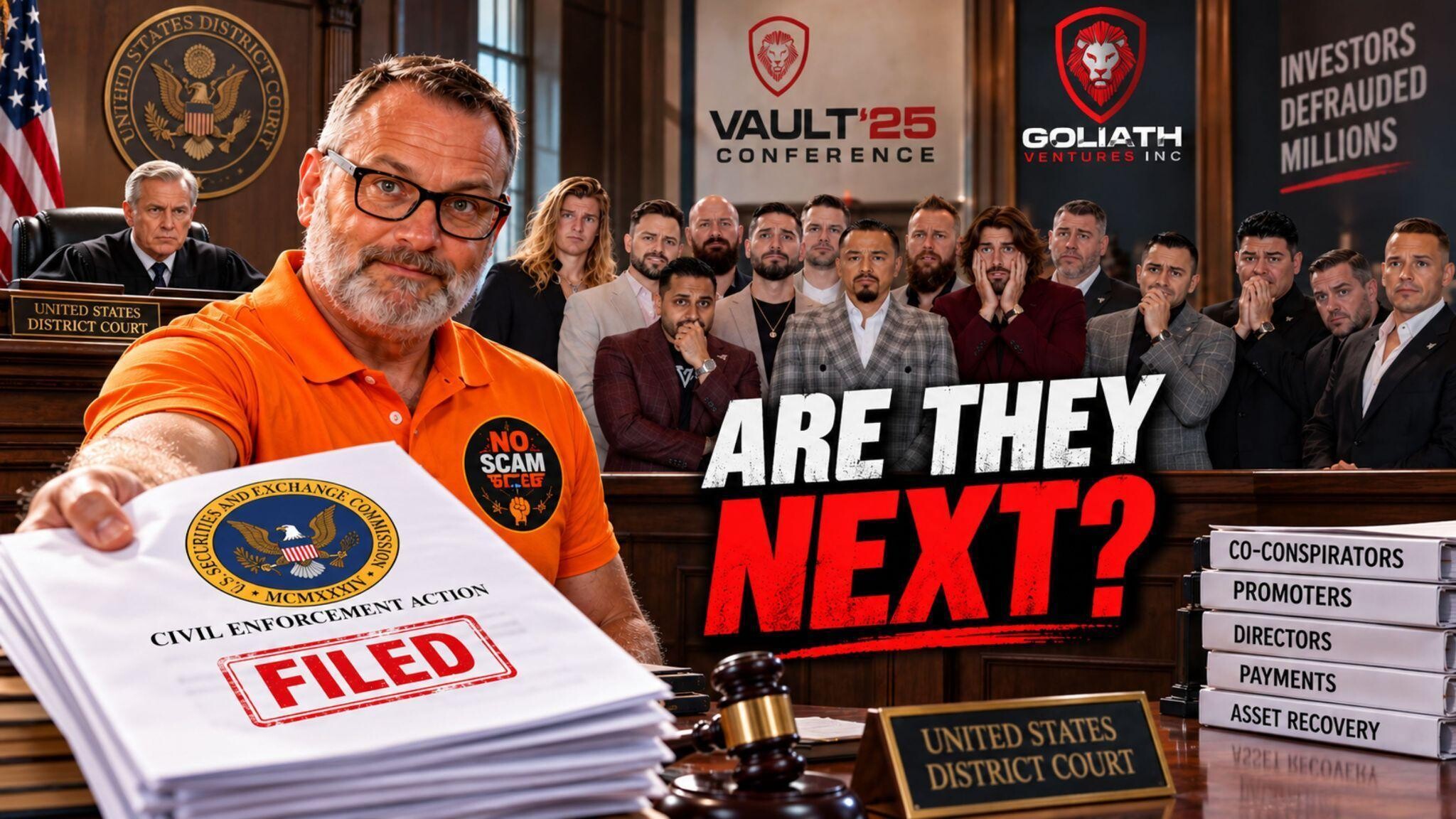
Christopher Delgado’s guilty plea has changed the trajectory of the Goliath Ventures investigation.
What began as a federal criminal case involving the company’s former chief executive has now developed into a broader legal story involving federal prosecutors, financial regulators, asset recovery and investors seeking answers about substantial losses.
Delgado has admitted guilt to federal offenses connected with the Goliath operation.
That development naturally raises another question:
Could the investigation now move beyond Delgado and focus more closely on other people who were involved with the company?
There is no public answer yet.
But the combination of Delgado’s guilty plea and separate actions by the Securities and Exchange Commission and Commodity Futures Trading Commission means the wider Goliath operation is receiving scrutiny from several directions.
A Major Turning Point
Delgado’s guilty plea represents a significant milestone.
Federal prosecutors say he pleaded guilty to conspiracy to commit wire fraud, wire fraud and money laundering. Authorities have stated that the conduct resulted in losses of at least $250 million.
He has also agreed to forfeit substantial assets associated with the case.
For investors, the plea is important because it provides a clearer legal resolution concerning Delgado himself.
For investigators, however, it may create a different set of questions.
A large financial operation involves people, transactions, communications and systems.
Understanding those elements may help authorities determine whether the misconduct was limited to one individual or whether others knowingly participated.
Looking Beyond the CEO
The fact that Delgado was the chief executive does not automatically mean other Goliath personnel were involved in wrongdoing.
That point deserves emphasis.
Companies employ people with different responsibilities and different levels of access to information.
Some employees may have understood the company’s operations in detail.
Others may have had limited knowledge.
Some may have believed the investment model was legitimate.
Others may have raised concerns.
An investigation must distinguish between those circumstances.
The central issue is not simply who worked for Goliath.
It is who knew what, who did what and when they knew it.
The SEC’s Expanding Role
The Securities and Exchange Commission has filed a civil enforcement action against Goliath Ventures and Delgado.
According to the SEC’s complaint, the company raised hundreds of millions of dollars from investors through representations involving cryptocurrency liquidity pools and investment returns.
The commission alleges that investor funds were not used as promised.
It further alleges that money was redirected for purposes including payments to earlier investors and personal expenditures.
These claims are allegations in a civil proceeding and remain subject to the legal process.
Nevertheless, the SEC action gives the public another detailed account of how regulators believe the operation functioned.
Why Regulatory Scrutiny Matters
The SEC’s investigation is important because it operates independently from Delgado’s criminal prosecution.
The commission can examine whether federal securities laws were violated and whether investors were given materially misleading information.
That can involve the investment offering itself, statements made during fundraising, promotional materials and the conduct of individuals involved in soliciting or managing investor funds.
If evidence identifies additional violations involving other individuals or entities, regulators could potentially take further action.
But that decision would depend on the evidence.
It would not follow automatically from Delgado’s guilty plea.
The CFTC’s Parallel Case
The SEC is not the only federal regulator examining Goliath.
The Commodity Futures Trading Commission has also filed a civil action concerning the company and Delgado.
The CFTC alleges that approximately 1,600 customers contributed at least $397 million and that customers were misled about the investment activity and returns associated with their funds.
The agency is pursuing financial and other remedies.
The parallel SEC and CFTC proceedings demonstrate how the Goliath matter has expanded into multiple areas of federal financial enforcement.
Following the Money
One of the most revealing parts of a financial investigation is often the movement of money.
Investigators can examine bank accounts, accounting records, cryptocurrency wallets and transfers between different entities.
They can then compare those transactions with company communications and representations made to investors.
That process can answer questions such as:
Where did investor money go?
Who authorized particular transfers?
Who received payments?
Which accounts were controlled by the company?
Were funds transferred to people or entities connected to company executives?
Did financial activity correspond with what investors had been promised?
The answers could help authorities reconstruct the operation.
The Digital-Asset Trail
Cryptocurrency adds another dimension to the investigation.
Digital assets can be transferred quickly between wallets and platforms, sometimes across international borders.
At the same time, many blockchain transactions leave a permanent public record.
That record can potentially allow investigators to reconstruct the movement of funds.
However, a wallet address does not automatically reveal the identity of its owner.
Investigators may need additional records from exchanges, financial institutions, communications and other sources to establish who controlled particular accounts.
The combination of blockchain analysis and conventional financial investigation can nevertheless be powerful.
What Delgado May Know
Delgado’s position within Goliath could make his knowledge particularly significant.
As a former executive, he may have information about company operations, financial decisions, investor communications and relationships with other participants.
But information supplied by a defendant is not automatically proof of another person’s wrongdoing.
Investigators must evaluate such information carefully.
They can compare statements against documents.
They can examine financial transactions.
They can search communications.
They can interview witnesses.
They can look for independent evidence.
Only after that process can authorities determine whether claims concerning other individuals are supported.
The Meaning of “Co-Conspirator”
The headline question uses the term “co-conspirators,” but that term should not be interpreted as establishing guilt for unnamed people.
A co-conspirator is not simply an employee, friend, business associate or person who appeared in company materials.
Legal responsibility requires evidence.
Someone may have worked for Goliath without understanding the alleged misuse of funds.
Someone may have promoted an investment while relying on information supplied by senior management.
Someone may have received legitimate compensation for legitimate work.
Each person’s circumstances would need to be examined individually.
That is why the next phase of the investigation should be judged by evidence rather than online speculation.
The Scale of the Alleged Losses
The financial figures surrounding Goliath are striking.
The Department of Justice says Delgado admitted to causing at least $250 million in losses.
The SEC alleges that Goliath raised at least $425 million from more than 1,300 investors.
The CFTC has referenced approximately $397 million contributed by about 1,600 customers.
The figures come from different proceedings and should not be treated as identical calculations.
Nevertheless, they demonstrate why the government response has become so extensive.
When the alleged financial impact reaches hundreds of millions of dollars, investigators have strong reasons to examine the full flow of funds.
Where Are the Assets?
Asset recovery may become one of the most important aspects of the case for investors.
Federal authorities have pursued a significant collection of assets associated with Delgado, including property and high-value personal possessions.
Such efforts are designed to preserve or recover property that may ultimately be subject to forfeiture or other legal remedies.
But recovering assets is not the same as immediately returning money to investors.
Property can be subject to competing claims.
Some funds may have already been spent.
Some assets may have declined in value.
Others may be difficult to trace.
The ultimate recovery for victims will therefore depend on the outcome of several legal processes.
Bankruptcy Adds Another Layer
Goliath’s bankruptcy proceedings introduce another mechanism through which the company’s finances can be examined.
Bankruptcy proceedings typically involve detailed information concerning assets, debts and creditor claims.
For investors, those proceedings may be particularly important because they can help determine what resources remain available and how competing claims will be addressed.
The bankruptcy case is separate from the criminal prosecution and regulatory lawsuits.
Nevertheless, all of these proceedings concern aspects of the same underlying financial history.
What Could Make the Investigation Expand?
If investigators begin looking more closely at other individuals, several forms of evidence could become important.
For example, authorities might examine whether someone knowingly:
- made false statements to prospective investors;
- concealed information about the use of customer funds;
- directed money for unauthorized purposes;
- created or distributed misleading investment materials;
- participated in financial transactions designed to conceal the movement of money;
- or received proceeds while understanding their alleged source.
These are investigative categories, not allegations against any particular unnamed person.
The evidence will determine whether any individual’s conduct crosses the relevant legal threshold.
The Importance of Communications
Money tells one story.
Communications can tell another.
Emails, text messages, internal chats, investor presentations and recorded conversations may establish what people knew at particular points in time.
For example, investigators could compare a public representation about an investment with internal communications concerning the actual use of funds.
If those records contradict one another, they could become important evidence.
Conversely, communications may show that a particular employee relied on information from management and had no knowledge of alleged misconduct.
Context matters.
The Difference Between Criminal and Civil Cases
The Goliath situation involves both criminal and civil proceedings.
Those cases should not be confused.
Delgado’s guilty plea concerns federal criminal offenses.
The SEC’s action is a civil enforcement proceeding.
The CFTC’s case is also civil.
The legal standards, remedies and procedures can differ significantly.
A civil allegation does not equal a criminal conviction.
Likewise, a person’s appearance in a regulatory filing does not automatically establish criminal liability.
Understanding those distinctions is essential when reporting on a developing financial investigation.
What Investors Should Watch
For people who invested money with Goliath, several developments may be particularly important.
First: Delgado’s sentencing and the continuing federal criminal proceedings.
Second: developments in the SEC’s civil action.
Third: developments in the CFTC case.
Fourth: asset-forfeiture and recovery proceedings.
Fifth: bankruptcy developments concerning Goliath’s remaining assets and liabilities.
Sixth: any future official announcements identifying additional defendants or enforcement targets.
These developments are more reliable indicators than rumors circulating on social media.
A Broader Lesson for Cryptocurrency Investors
The Goliath case also illustrates why investors should look beyond impressive terminology.
An investment opportunity can be described using sophisticated concepts involving blockchain technology, liquidity pools or digital assets.
But technical language does not guarantee financial legitimacy.
Potential investors should understand how their money will generate returns.
They should determine who controls their funds.
They should investigate whether financial information can be independently verified.
They should understand withdrawal procedures.
And they should be cautious about promises of unusually high or consistent returns.
The technology may be new.
The basic questions are not.
The SEC’s Next Move
Will the SEC eventually pursue other individuals?
That remains unknown.
The commission has already taken action against Goliath Ventures and Delgado.
Whether that action expands will depend on the evidence gathered during the investigation and litigation.
If regulators identify additional individuals who violated federal securities laws, further enforcement could follow.
If the evidence does not establish such violations, additional action should not be assumed.
The responsible position is therefore to watch the official filings rather than predict names.
The Investigation Has Entered a New Phase
Delgado’s guilty plea has provided a significant answer to one part of the Goliath investigation.
But it has also placed renewed attention on the larger structure surrounding the company.
The SEC is pursuing its own claims.
The CFTC has filed a parallel case.
Federal authorities are pursuing assets.
Bankruptcy proceedings are addressing the company’s financial affairs.
And investors continue to seek explanations for what happened to their money.
The question now is whether the evidence ultimately identifies additional individuals who knowingly participated in unlawful conduct.
Closing In—or Simply Looking Closer?
It may be too early to say that the SEC is “coming for” anyone beyond the defendants already identified in its complaint.
But regulators are clearly examining the Goliath operation from multiple angles.
That alone makes the next stage worth watching.
If financial records, communications and testimony reveal a broader pattern of knowing participation, the legal consequences could expand.
If they do not, Delgado’s guilty plea may remain the central criminal resolution of the matter.
Either way, the evidence—not speculation—will determine what happens next.
For investors, the priority is recovery and accountability.
For regulators, it is establishing the facts.
And for the public, the most important question is not simply whether more names will appear.
It is whether the full story of Goliath Ventures will eventually become clear.